Loading...
Test Subscribe to our newsletter
Get the latest posts, updates, and insights delivered straight to your inbox

The ultimate L&D solution for upskilling your workforce


About Us
© 2026 SkillUp MENA, Inc. All rights reserved
Test Subscribe to our newsletter
Get the latest posts, updates, and insights delivered straight to your inbox
The ultimate L&D solution for upskilling your workforce
© 2026 SkillUp MENA, Inc. All rights reserved

 Share :


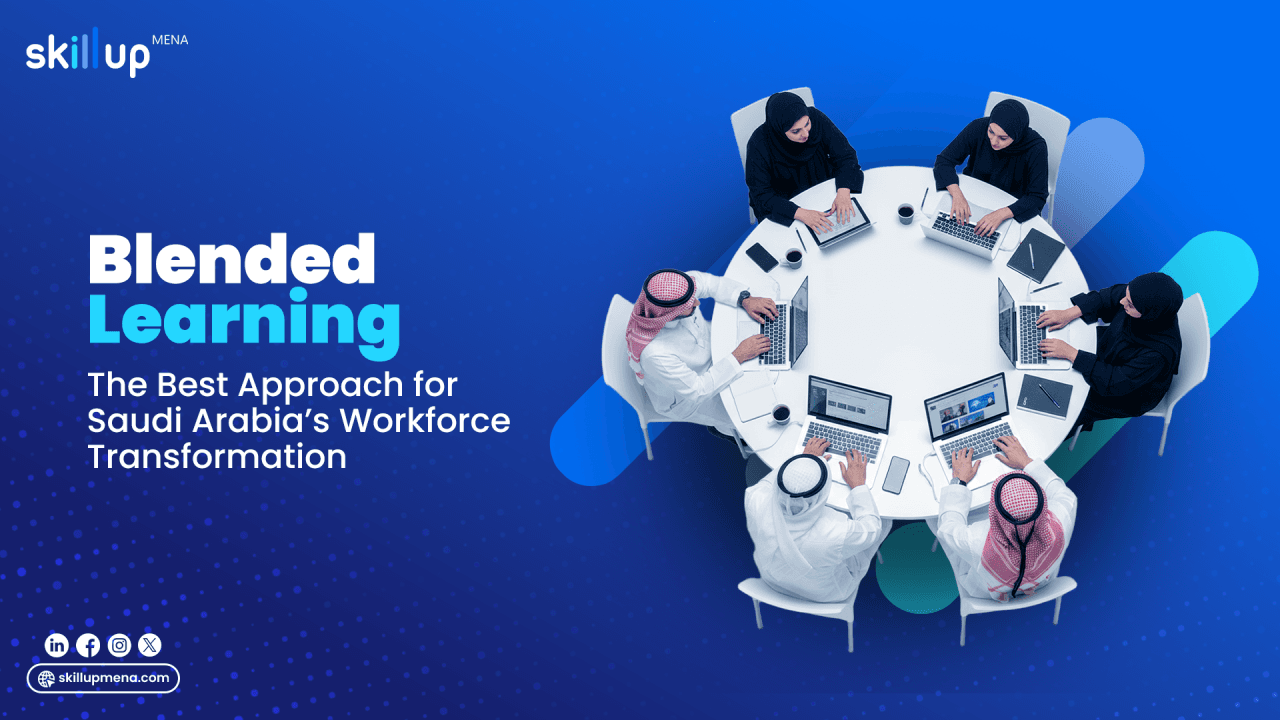
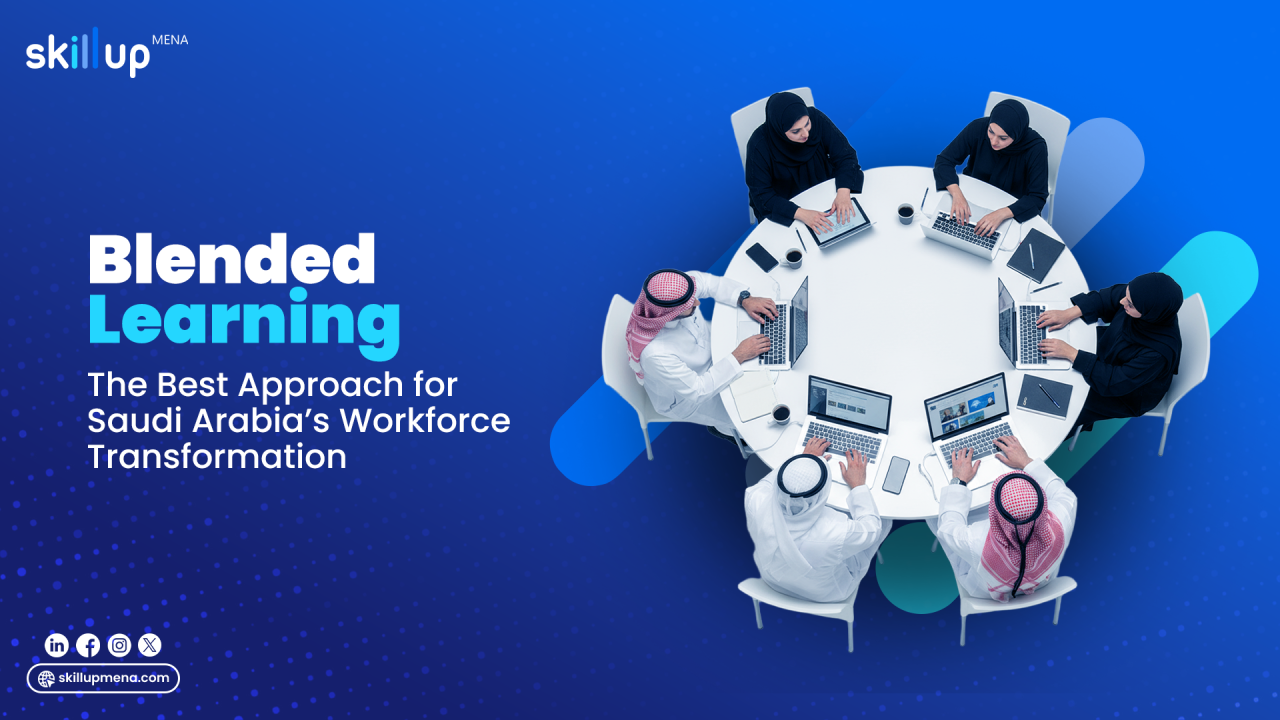
Saudi Arabia is experiencing rapid transformation under Vision 2030, with a national focus on diversifying industries, upskilling the workforce, and preparing employees for the future of work. Yet, one challenge persists: how do organizations provide training that is both culturally familiar and future-ready?
The answer lies in blended learning — a model that combines the strengths of face-to-face workshops with the flexibility of digital learning platforms.
Reliance on Face-to-Face Training
Employees are accustomed to instructor-led programs, often traveling for 2–3 days to attend certified workshops.
These programs carry high credibility but are episodic and limited in impact once the workshop ends.
Perceptions of E-Learning
Self-paced online learning is still relatively new in Saudi Arabia.
Many professionals see e-learning as foreign, lacking tangible outcomes compared to certified in-person training.
Adoption can be slow, and engagement often drops when learners don’t see immediate results.
Missed Opportunities for Regular Upskilling
While workshops provide recognition, they rarely cover the soft skills, leadership skills, and continuous development employees need for long-term growth.
Organizations struggle to sustain momentum between major training events.
Blended learning bridges this gap by combining the credibility of traditional methods with the scalability of digital solutions.
Start with Familiarity
Anchor programs with in-person kick-offs or certified workshops to build trust.
Integrate Microlearning
Deliver short, bite-sized online modules that reinforce core skills and keep employees engaged.
Localize for Impact
Offer bilingual content (Arabic/English) and case studies tailored to Saudi industries.
Leverage Data & AI
Use smart learning platforms to personalize learning paths and track engagement.
Balance Hard & Soft Skills
Blend compliance/technical training with soft skills development to align with Vision 2030 goals.
Organizations in Saudi Arabia adopting blended learning see measurable benefits:
At Skillup MENA, we specialize in designing blended learning solutions tailored for the region. Our expertise includes:
Saudi Arabia’s workforce doesn’t need to choose between traditional credibility and modern flexibility — blended learning brings both together.
As nations pursue ambitious economic diversification goals, with Saudi Arabia’s Vision 2030 leading the charge, organizations face a critical question: How do we upskill our workforce while respecting cultural preferences and maximizing impact?
The answer isn’t choosing between traditional training and digital innovation. It’s simply combining them through blended learning.
Across the MENA region, and particularly in Saudi Arabia, organizations are trying to cope with familiar challenges. The corporate learning landscape is dominated by instructor-led workshops where employees travel for 2-3 days to attend certified programs. These sessions carry tremendous credibility and provide valuable networking opportunities, but they’re episodic events that often end when participants return to their offices.
Meanwhile, e-learning platforms promise scalability and flexibility, yet adoption remains inconsistent. Many professionals in the region view online learning as impersonal or lacking the tangible outcomes they expect from training investments. In Saudi Arabia specifically, where face-to-face interactions hold deep cultural significance, purely digital solutions often struggle to gain traction.
This creates a gap: employees need continuous development to thrive in evolving industries, but current training models aren’t designed for sustained impact.
Blended learning offers a strategic solution that honors traditional preferences while embracing digital efficiency. By combining the credibility of in-person workshops with the accessibility of online modules, organizations can create learning experiences that resonate culturally and deliver measurable results.
Geographic Reach: With dispersed teams across major cities — from Riyadh and Jeddah to Dubai, and Cairo — blended models reduce travel costs while maintaining instructor access.
Cultural Sensitivity: The approach preserves the relationship-building aspect of traditional training while gradually introducing digital components as natural extensions rather than replacements.
Language Flexibility: Programs can seamlessly integrate Arabic and English content, reflecting the bilingual reality of modern MENA workforces.
Sustained Engagement: Unlike standalone workshops, blended programs create ongoing learning journeys that reinforce key concepts and build habits over time.
Saudi Arabia presents a compelling case study for blended learning implementation. The Kingdom’s rapid transformation under Vision 2030 demands workforce development at unprecedented scale and speed. Organizations are investing heavily in upskilling initiatives, but they need approaches that work within existing cultural frameworks while preparing employees for future challenges.
Successfully launching blended learning in MENA requires thoughtful implementation that respects local contexts while driving modern outcomes.
Start with Trust-Building: Anchor programs with familiar in-person elements; kickoff sessions, certified workshops, or instructor-led components. This builds confidence before introducing digital elements.
Design for Reinforcement: Use online modules to reinforce and expand on workshop content rather than replacing face-to-face interaction entirely. Short, focused digital sessions work better than lengthy e-learning courses.
Localize Meaningfully: Go beyond translation to create content that reflects regional business contexts, case studies, and cultural nuances. Saudi professionals respond to examples from their industries and markets.
Leverage Smart Technology: Modern learning platforms can personalize experiences, track progress, and provide insights that help both learners and L&D teams optimize programs continuously.
Balance Skill Development: Combine technical training with leadership development, emotional intelligence, and other soft skills that Vision 2030 and similar regional initiatives prioritize.
Organizations implementing blended learning across MENA are seeing tangible returns on their training investments:
The success of blended learning often depends on the underlying technology platform. Modern learning management systems offer AI-powered personalization, mobile accessibility, and analytics that help organizations understand what’s working and what isn’t.
Platforms like Totara TXP are particularly well-suited to blended approaches, offering the flexibility to combine various learning modalities while providing the data insights that L&D teams need to continuously improve their programs.
The shift toward blended learning represents more than a training methodology change — it’s part of the broader digital transformation sweeping across MENA. As the region positions itself as a global hub for innovation and business, workforce development approaches must evolve to match these ambitions.
Saudi Arabia’s early adoption of blended learning models positions the Kingdom as a regional leader in progressive training approaches. Other MENA markets are watching closely, ready to adapt successful strategies to their own cultural and business contexts.
For organizations considering blended learning, the key is starting strategically rather than perfectly. Begin with pilot programs that combine trusted workshop formats with simple digital reinforcement. Measure engagement and outcomes, and make the needed changes based on learner feedback and business results.
The goal isn’t to revolutionize training overnight but to evolve existing approaches in ways that honor cultural preferences while unlocking the scalability and effectiveness that digital tools provide.
Skillup MENA specializes in designing culturally-aware blended learning solutions for organizations across the region. From content digitization and custom localization to technology integration and ongoing support, we help companies build learning programs that work within local contexts while driving global-standard results.
Ready to explore how blended learning can transform your organization’s training approach? Let’s discuss your specific needs and cultural context.